Published by LuxTurfscape on . Reviewed .
What the law says
Section 4735 is part of the Davis-Stirling Common Interest Development Act, the state law that governs HOAs. Its current text was last amended in 2015 by AB 786. It voids any provision of the governing documents, or of architectural or landscaping guidelines or policies, that does any of the following:
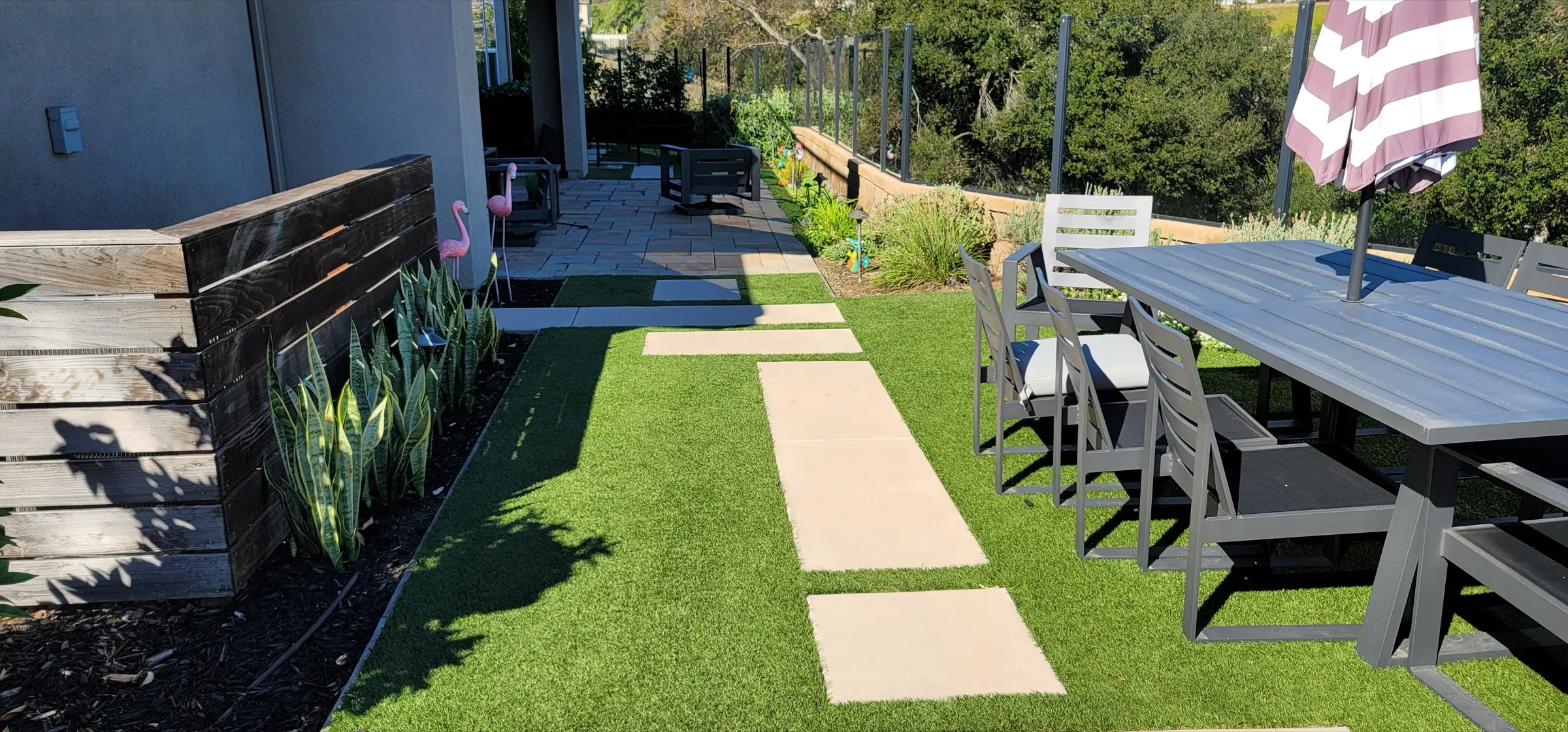
- Prohibits, or has the effect of prohibiting, artificial turf or any other synthetic surface that resembles grass
- Prohibits, or has the effect of prohibiting, low water-using plants, as a group or as a replacement for existing turf
- Has the effect of prohibiting or restricting compliance with a local water-efficient landscape ordinance, or with water-use restrictions adopted under the Water Code
What an HOA can still require
The law says it does not stop an association from applying the landscaping rules in its governing documents, "to the extent the rules fully conform" with the ban above. So an HOA may keep an approval process and landscaping guidelines. It cannot use them to make turf impossible.
If your HOA asks for an application before you install turf, submit it. A rule that no turf product could meet is the kind of condition the law voids.
No fines for watering less during a drought
While the Governor or a local government has declared a drought emergency, an HOA cannot fine or assess an owner for reducing or stopping the watering of lawns and plants. The exception is an owner who receives recycled water from their water supplier and does not use it for landscape irrigation. When the emergency ends, an owner who put in water-efficient landscaping in response does not have to remove it.
Common areas are a board decision
Section 4735 deals with rules applied to owners. It does not require a board to convert common-area lawns, and it does not stop one from doing so. Common-area landscaping is decided by the board under the governing documents.
A separate law is pushing that decision. AB 1572, signed in October 2023 and now Water Code section 10608.14, bans using potable (drinking) water to irrigate nonfunctional turf on commercial, industrial, and institutional properties and on HOA common areas. Functional turf is turf in a recreational use area or community space. Everything else is nonfunctional, including turf in street rights-of-way and parking lots. Drinking water can still be used to keep trees and other perennial plants healthy. The deadlines:
- January 1, 2027: properties owned by state and local government agencies and public water systems
- January 1, 2028: other institutional properties, and all commercial and industrial properties
- January 1, 2029: common areas of HOAs and other common interest developments
Boards will have to certify compliance
The State Water Resources Control Board says covered properties, including HOAs and common interest developments, must certify their compliance to the Board. As of October 29, 2026, its page lists the compliance certification form as coming soon. Watch the Board’s AB 1572 page for the form.
What boards can do now
Boards with decorative common-area lawns have until January 1, 2029, to stop watering them with drinking water. The choices are to convert them to artificial turf, convert them to low-water planting, switch to recycled water where it is available, or stop watering them. Walking the common areas sorts which lawns people use for play and gatherings and which are decorative. Spreading the work over two or three budget years is easier than converting everything in the last one.